WTM Visual Intelligence · Conceptual imagery
Follow enterprise, markets, ownership and leadership through the systems that create value and distribute influence.

America became dramatically wealthier during the second quarter of 2026. The Federal Reserve calculates that household and nonprofit net worth increased by approximately $12.8 trillion in three months, reaching $195.9 trillion. Corporate equity holdings accounted for roughly $10.7 trillion of that quarterly increase. On paper, it was an extraordinary expansion of American wealth. But paper wealth and lived prosperity are not synonymous. Consumer prices in August were 3.4% higher than a year earlier, while real average hourly earnings for private-sector employees were 0.3% lower. A worker can therefore watch the country’s aggregate balance sheet expand while discovering that the same hour of labour buys slightly less. Neither statistic invalidates the other. They are measuring different economies. WTM proposes that Americans increasingly experience three overlapping economic systems: the Wage Economy, which determines what labour pays; the Cost Economy, which determines what life requires; and the Asset Economy, which determines what accumulated ownership does without another hour of labour being sold. The distribution matters. Federal Reserve data for the first quarter of 2026 show that the bottom half of households collectively held only about $590 billion in corporate equities and mutual-fund shares. The top 0.1% alone held approximately $13.33 trillion; the remainder of the top 1% held another $14.31 trillion. Rising markets can therefore increase national wealth enormously without distributing the increase evenly. This is not evidence of a conspiracy. It is evidence of architecture. The American wealth divide is not only about who earns more. It is increasingly about who owns the machinery that compounds while everyone else is working. The question for the household is consequently not merely: How much do I make? It is: What enters my wallet, what leaves it, what compounds against me — and what do I own that can compound for me?

Corporate life operates through two architectures simultaneously: the organisation formally described through titles, reporting lines, performance systems and policies, and the organisation actually experienced through trust, reputation, sponsorship, visibility, relationships, timing and power. Excellence matters. But excellence that cannot travel through an institution can remain professionally stranded. Drawing upon an anonymised real-world corporate experience — stripped of employer, industry, geography, chronology and personally identifiable circumstances — this editorial examines what happens when a high-performing professional discovers that doing the work and understanding the system governing the work are different capabilities. The sustainable lesson is neither cynicism nor manipulation. It is institutional intelligence: learning how power works without surrendering one’s principles to obtain it.

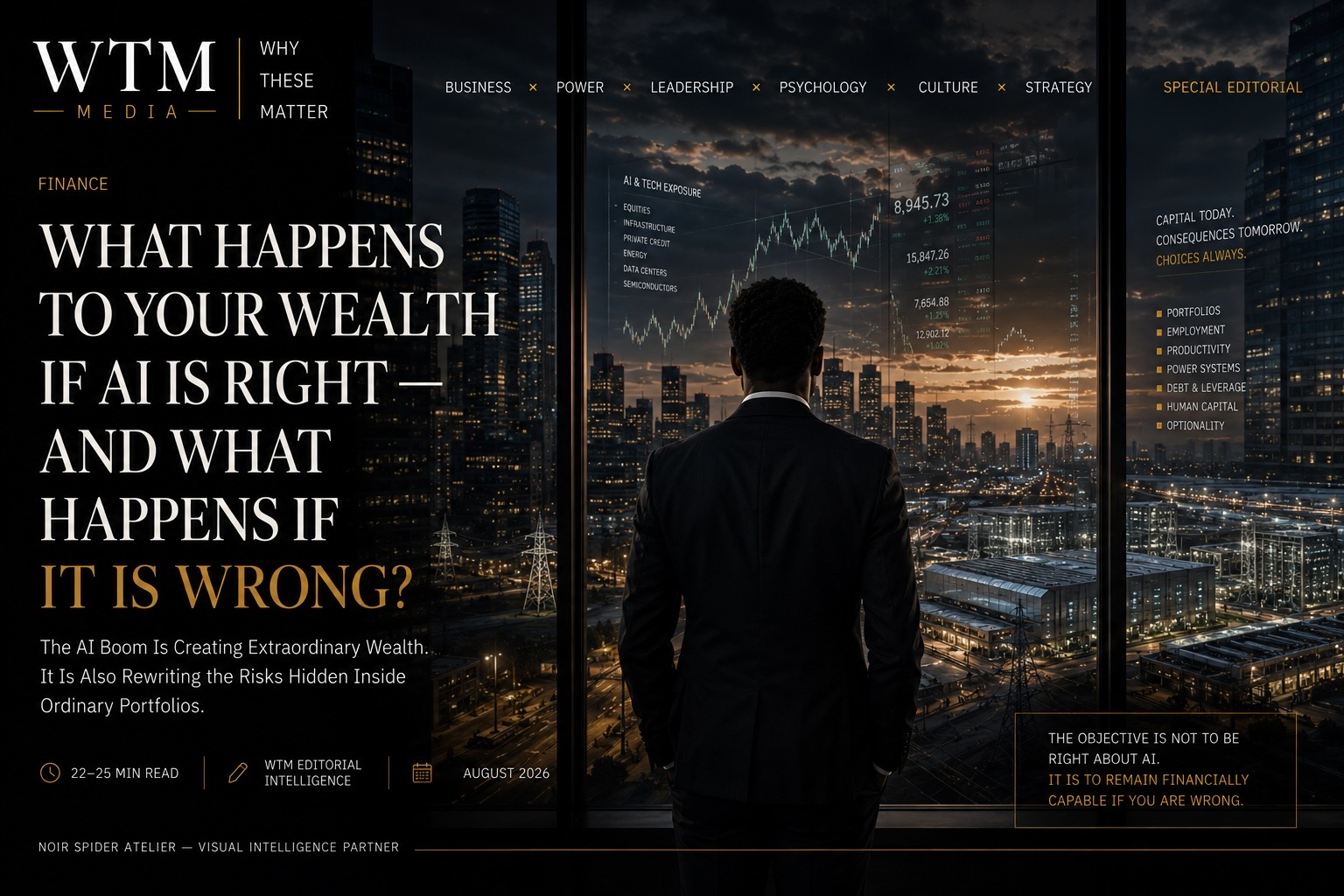
Artificial intelligence is being sold through two futures at once. In one, it becomes the great productivity engine of the twenty-first century: making workers more capable, companies more profitable, science faster and economies richer. In the other, it displaces workers, concentrates power, destabilises industries and leaves millions economically exposed. Investors are often encouraged to choose between these narratives. They should resist. Both can occur simultaneously. The more consequential question is whether household wealth has been designed to survive either outcome. The AI boom is no longer confined to technology shares. It is moving through data centres, electricity systems, corporate debt, private credit, retirement portfolios, labour markets and government policy. The IMF says equity-market concentration around AI has continued to intensify. The BIS describes one of the largest technology-driven investment booms in American history, increasingly financed through debt. Reuters calculates that five major technology companies have accumulated approximately $1.09 trillion in future lease commitments, predominantly connected to data-centre expansion. Yet the ILO finds that the productivity gains from generative AI are real but uneven, while mass employment displacement has not yet occurred. These facts do not describe either a certain bubble or a guaranteed revolution. They describe something more difficult: a system undergoing simultaneous technological, financial and labour-market repricing. For households, that requires a different conception of diversification. Your wealth is not merely what sits inside your brokerage account. It includes your earnings capacity, liquidity, debt obligations, property, pension, professional skills and ability to absorb disruption. Someone can therefore become wealthier on paper because AI-related equities are appreciating while simultaneously becoming more economically vulnerable because AI threatens the income financing their life. The objective is not to predict AI perfectly. It is to construct sufficient financial resilience that several plausible futures remain survivable


For much of the post-financial-crisis era, wealthy economies became accustomed to an extraordinary condition: money was cheap. Governments could borrow heavily, companies could finance expansion at modest rates, asset prices could rise on abundant liquidity, and households learned to treat low-cost mortgages as something approaching economic normality. That world is disappearing fast. Across major economies, long-term government borrowing costs have climbed towards levels not seen for years or decades. On 17 August, the US 30-year Treasury yield reached roughly 5.31 per cent, its highest level since 2007. Japan’s 10-year government bond yield subsequently approached 2.95 per cent, a three-decade high, while German borrowing costs have risen to 15-year highs. The OECD describes the present combination of elevated financing requirements and elevated yields as exceptional compared with the previous two decades. Behind those numbers is a larger structural contest. Governments need capital for debt refinancing, defence, infrastructure, pensions, healthcare and climate resilience. Technology companies require extraordinary sums for artificial-intelligence infrastructure. Energy systems require grids, generation and storage. Businesses require investment. Families require mortgages and credit. These demands do not occupy separate universes. They ultimately encounter the same fundamental economic resource: capital. And when many powerful institutions want more of it simultaneously, the price of money stops being an obscure financial-market variable. It becomes a question of who gets financed, at what price, and at whose expense.

Most headlines describe Citigroup’s technology transformation as another expensive digital modernisation programme. That framing misses the larger story; the real transformation is institutional. Technology has become the visible expression of something much deeper: organisational redesign. Under CEO Jane Fraser, Citi is attempting one of the most complex reinventions in modern banking—not merely replacing ageing software, but rebuilding governance, simplifying decision-making, redesigning accountability, reducing organisational complexity, and restoring confidence after years of regulatory scrutiny.Tim Ryan’s arrival from PwC represents more than a technology appointment. It reflects a growing recognition that technology leaders increasingly function as institutional architects. Their responsibility is no longer confined to servers, software, or cybersecurity. They now redesign how information moves, how decisions are made, how risks are managed, and ultimately, how organisations earn trust. The future of banking will not be determined by whichever institution deploys the most artificial intelligence. It will belong to those capable of redesigning themselves whilst continuing to operate at global scale.

Artificial intelligence is dominating boardrooms, classrooms and governments. Yet the most important question is not whether AI will replace jobs. It is this: What becomes valuable when intelligence becomes abundant? Throughout history, every major technology has changed the value of human work rather than eliminating humanity itself. Steam power rewarded industrial organisation. Electricity rewarded scale. The internet rewarded information. Artificial intelligence rewards judgement. The companies creating the greatest long-term value are not reducing people. They are redesigning work around the capabilities machines cannot replicate. This is no longer an AI story. It is a human story.

For more than two centuries, work has been organised around a simple assumption: people travel to places where economic activity occurs. Factories required physical presence. Offices centralised coordination. Cities emerged as concentrations of labour, capital, and opportunity. COVID-19 shattered this assumption almost overnight. Remote work demonstrated that many knowledge-based professions were never dependent upon offices themselves but upon the coordination functions offices provided. Simultaneously, artificial intelligence has begun transforming the nature of labour itself, automating cognitive tasks once considered immune to technological disruption. Together, these forces are producing a fundamental redesign of work. The future is not a world without jobs. It is a world where work becomes increasingly distributed, augmented, fluid, and continuously adaptive. The office was never the point. Coordination was. The organisations, workers, and societies that understand this distinction may gain extraordinary advantages in the decades ahead.

For centuries, civilisation has measured wealth by accumulation. Net worth rankings, stock portfolios, market capitalisation and billionaire lists dominate headlines because they are easy to quantify. Yet the largest economic question begins only after wealth has already been created: what should happen next? Modern philanthropy has entered a remarkable period of experimentation. Figures such as MacKenzie Scott, Warren Buffett and Bill Gates have redirected enormous fortunes toward education, healthcare, scientific research and community organisations. Their approaches differ, but together they raise a deeper systems question that extends beyond individual generosity: is wealth ultimately designed to be owned, or to circulate? The answer reaches far beyond billionaires. It influences governments, families, entrepreneurs, investors and every individual who hopes to leave the world marginally better than they found it. Giving is not simply an emotional act. It is a form of capital allocation capable of shaping institutions, incentives, innovation and future generations. Understanding how generosity works may therefore become one of the most valuable forms of economic intelligence.

Every economic cycle produces a new list of billionaires. Markets celebrate valuations. Media celebrates personalities. Social media celebrates lifestyles. Yet almost none of these conversations explain the architecture that made such fortunes possible. Wealth is visible. The systems that create it are not. The announcement that investor and telecommunications entrepreneur David Grain joined the ranks of America’s Black billionaires offers an opportunity to examine those deeper systems rather than celebrate another individual success story. Grain’s achievement deserves recognition, but its greater value lies in what it reveals about capital allocation, ownership, enterprise building, governance and long-term stewardship. These are the quiet disciplines that consistently separate enduring institutions from temporary success.