Conceptual mountain panorama with mist and dramatic light.

WTM Visual Intelligence · Conceptual imagery

WTM EDITORIAL INTELLIGENCE

Independent perspectives on people, culture, power and the systems shaping society. Explore the evidence, ideas and consequences behind the headlines.

THE WTM ARCHIVE

Find the intelligence you need.

Explore past editorials by subject or question. Return to an idea. Put it to work.

Browse the latest published editorials below.

Need a starting point? Explore three curated reading pathways
Africa’s HIV Breakthrough Signals a New Research Era

Africa’s HIV Breakthrough Signals a New Research Era

For more than four decades, HIV has been one of humanity’s defining public health challenges. Scientific breakthroughs have transformed HIV from a near-certain fatal diagnosis into a manageable chronic condition for millions, yet an effective vaccine has remained elusive. Now, African scientists are helping to reshape that narrative. Recent advances led by researchers across Africa demonstrate a profound shift in global biomedical research. Rather than serving merely as sites for clinical trials designed elsewhere, African laboratories, universities, hospitals, biotechnology companies, and research institutions are increasingly driving scientific discovery themselves. The continent is becoming an architect of medical innovation rather than simply a participant. The implications extend well beyond HIV. The same scientific infrastructure, genomic expertise, artificial intelligence, manufacturing capacity, and collaborative research ecosystems developed through HIV programmes are positioning Africa to contribute to vaccines, cancer therapies, precision medicine, pandemic preparedness, and biotechnology for decades to come. This editorial argues that Africa’s latest HIV research milestone is not only a medical story. It is evidence that the geography of scientific leadership is changing. Nations that invest consistently in research, talent, institutions, and collaboration will increasingly determine the future of global health.

Invisible Solar Windows Will Redesign Cities

Invisible Solar Windows Will Redesign Cities

For more than a century, windows have performed a simple function: admitting daylight while separating people from the elements. In the decades ahead, they may become something far more consequential. Transparent photovoltaic technologies promise to transform ordinary glass into distributed energy infrastructure, allowing buildings to generate electricity without sacrificing visibility or architectural aesthetics. Although today’s transparent solar technologies remain less efficient than conventional rooftop photovoltaic systems, their significance lies elsewhere. Modern cities contain billions of square metres of glazing across office towers, hospitals, universities, airports, residential developments, shopping centres, and transport hubs. Collectively, those transparent surfaces represent one of the largest underutilised assets within the built environment. If even a fraction of them become energy-generating façades, architecture itself begins evolving from a passive consumer of electricity into an active producer. The implications extend well beyond engineering. Invisible solar windows touch urban planning, construction economics, energy resilience, climate adaptation, property investment, national infrastructure, and public policy. They challenge a long-standing assumption that renewable energy must be visually separate from the buildings it serves. Instead, electricity generation becomes embedded within architecture itself. This is not merely another renewable-energy innovation. It represents a gradual redesign of how cities function, how buildings create value, and how the built environment participates in the energy system.

Fictional community reader in conversation with two interracial couples in an arts space.
Conceptual scene · Noir Spider Atelier. Fictional adults.

Join WTM Media Support Circle

WTM Media is independently funded and reader-supported. Contributions help sustain rigorous journalism, editorial research, interviews, and long-form analysis across design, systems, governance, technology, and culture.

Support via Stripe · $5/monthDiscuss support
Visual Intelligence · The Download Room

A perspective worth keeping.

Browse downloadable Visual Intelligence from WTM’s published editorials. Open a PDF to save it, and return to the full story for context.

Published editions · PDF downloads · Editorial context included

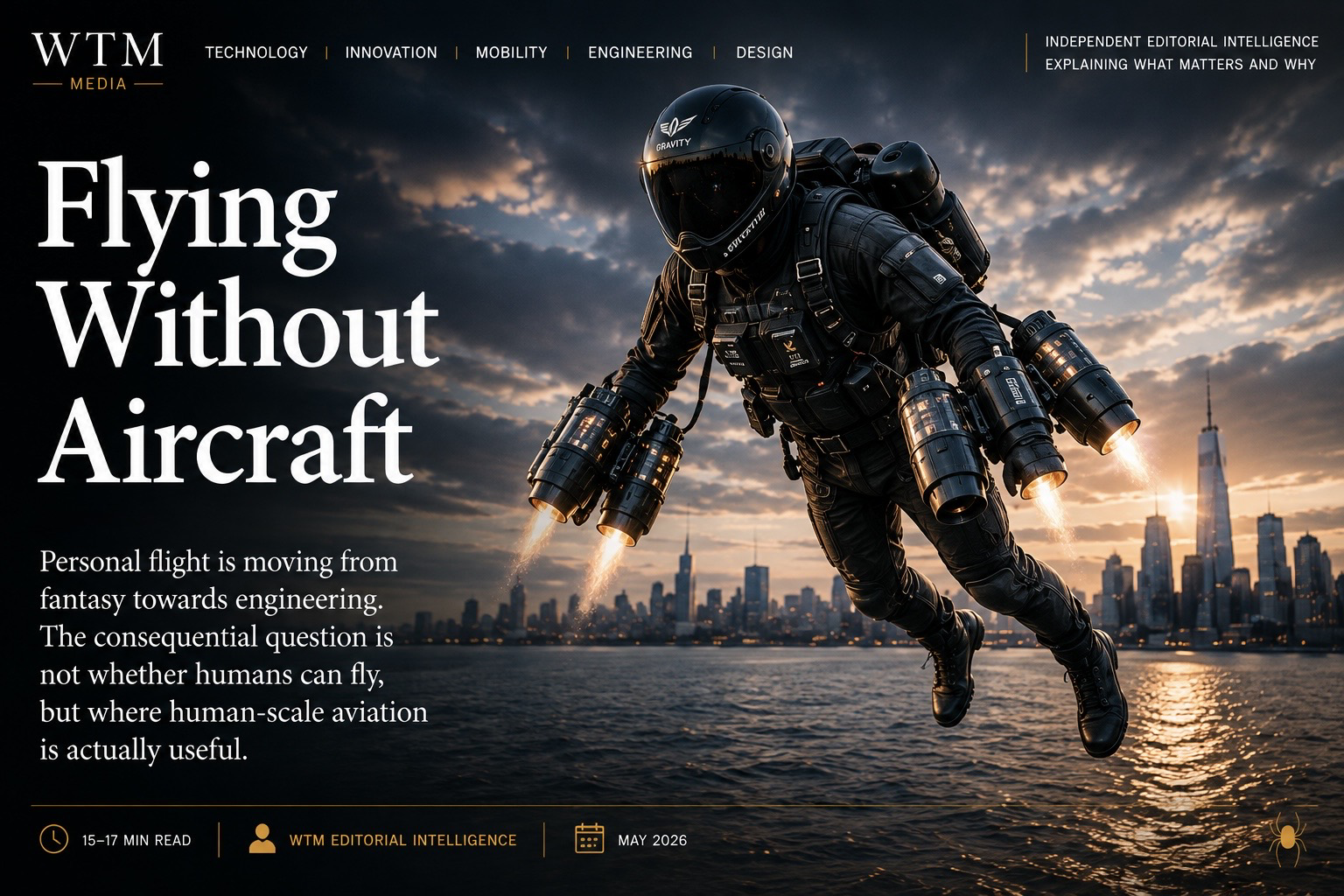
Flying Without Aircraft Is Already Here

Flying Without Aircraft Is Already Here

For most of aviation history, human flight has required an aircraft: a machine large enough to generate lift, carry fuel, accommodate passengers, and surround its occupants with an engineered structure. Emerging personal-flight technologies are beginning to loosen that relationship. Jet suits, powered wings, compact electric vertical-lift systems, autonomous drones, and increasingly sophisticated flight-control technologies suggest that aviation may eventually encompass machines worn, mounted, or summoned rather than conventionally boarded. The viral spectacle is irresistible. A person rises from the ground, accelerates over water, and appears to have acquired a superpower. Yet spectacle obscures the engineering. Human-scale powered flight confronts brutal constraints involving energy density, heat, noise, stability, endurance, payload, weather, redundancy, training, regulation, and the consequences of mechanical failure. A technology can fly successfully and still be unsuitable for mass transportation. That distinction is central to understanding personal aviation. The most plausible near-term applications are unlikely to involve commuters casually flying between homes and offices. Specialist environments — emergency response, defence, offshore infrastructure, inaccessible terrain, inspection, rescue, and certain industrial operations — provide a more credible pathway because the economic value of reaching somewhere quickly can outweigh the technology’s considerable limitations. The deeper development, however, extends beyond jet suits. Aviation is becoming computational. Sensors can stabilise machines faster than human reflexes. Software can continuously adjust thrust. Lightweight materials reduce mass. Autonomous navigation increasingly separates piloting from constant manual control. Electric propulsion enables aircraft configurations that would have been impractical under traditional mechanical architectures. The result is not necessarily the death of the aeroplane. Commercial aircraft remain extraordinarily efficient at moving large numbers of people over long distances. Instead, aviation may be fragmenting into a richer ecosystem: aircraft for distance, drones for autonomous logistics, eVTOL systems for specialised regional movement, and wearable or highly compact systems for particular human-scale missions. The important question is therefore no longer simply, “Can a person fly without an aeroplane?” We already know that certain machines can make that possible. The better question is: when does removing the aircraft make flight more useful?


Download Visual Intelligence ↓
How Much Is Actually In Your Wallet?

How Much Is Actually In Your Wallet?

America became dramatically wealthier during the second quarter of 2026. The Federal Reserve calculates that household and nonprofit net worth increased by approximately $12.8 trillion in three months, reaching $195.9 trillion. Corporate equity holdings accounted for roughly $10.7 trillion of that quarterly increase. On paper, it was an extraordinary expansion of American wealth. But paper wealth and lived prosperity are not synonymous. Consumer prices in August were 3.4% higher than a year earlier, while real average hourly earnings for private-sector employees were 0.3% lower. A worker can therefore watch the country’s aggregate balance sheet expand while discovering that the same hour of labour buys slightly less. Neither statistic invalidates the other. They are measuring different economies. WTM proposes that Americans increasingly experience three overlapping economic systems: the Wage Economy, which determines what labour pays; the Cost Economy, which determines what life requires; and the Asset Economy, which determines what accumulated ownership does without another hour of labour being sold. The distribution matters. Federal Reserve data for the first quarter of 2026 show that the bottom half of households collectively held only about $590 billion in corporate equities and mutual-fund shares. The top 0.1% alone held approximately $13.33 trillion; the remainder of the top 1% held another $14.31 trillion. Rising markets can therefore increase national wealth enormously without distributing the increase evenly. This is not evidence of a conspiracy. It is evidence of architecture. The American wealth divide is not only about who earns more. It is increasingly about who owns the machinery that compounds while everyone else is working. The question for the household is consequently not merely: How much do I make? It is: What enters my wallet, what leaves it, what compounds against me — and what do I own that can compound for me?

Download Visual Intelligence ↓
America Is Voting Inside A World That Has Already Changed

America Is Voting Inside A World That Has Already Changed

On 3 November, Americans will elect all 435 members of the House of Representatives and decide 35 Senate contests: 33 regularly scheduled Class II elections and two special elections. Yet describing the event as 470 congressional races understates what is actually being allocated. Congress is not simply another arena for the country’s political arguments. It is part of the machinery through which those arguments become law, money, appointments, investigations, military authority and international commitments. Its constitutional powers include appropriations and war authorities; the Senate participates in treaties and confirmations; and congressional committees oversee executive operations. The numerical paradox is striking. Every House district will vote, yet Reuters identifies only about 50 of 435 House contests as meaningfully competitive and reports that Democrats require a net gain of three seats to take the chamber. In the Senate, Reuters identifies nine especially consequential contests, with Democrats needing four additional seats for control. These are not predictions. They reveal something structurally important: enormous national power can turn on comparatively small electorates. And the country holding this election is operating in a world that is not waiting for the result. War and instability are affecting energy markets. Treasury yields have approached 5%. Russia’s war against Ukraine continues. Gulf states are pursuing diplomatic calculations of their own. Trade partners are developing leverage against American policy. WTM therefore treats the 2026 midterms not principally as a referendum on a president, party or ideology, but as an institutional allocation event. The relevant question is larger than who wins. What governing capacity will America possess after the votes are counted — and what will the rest of the world conclude from the answer?

Download Visual Intelligence ↓
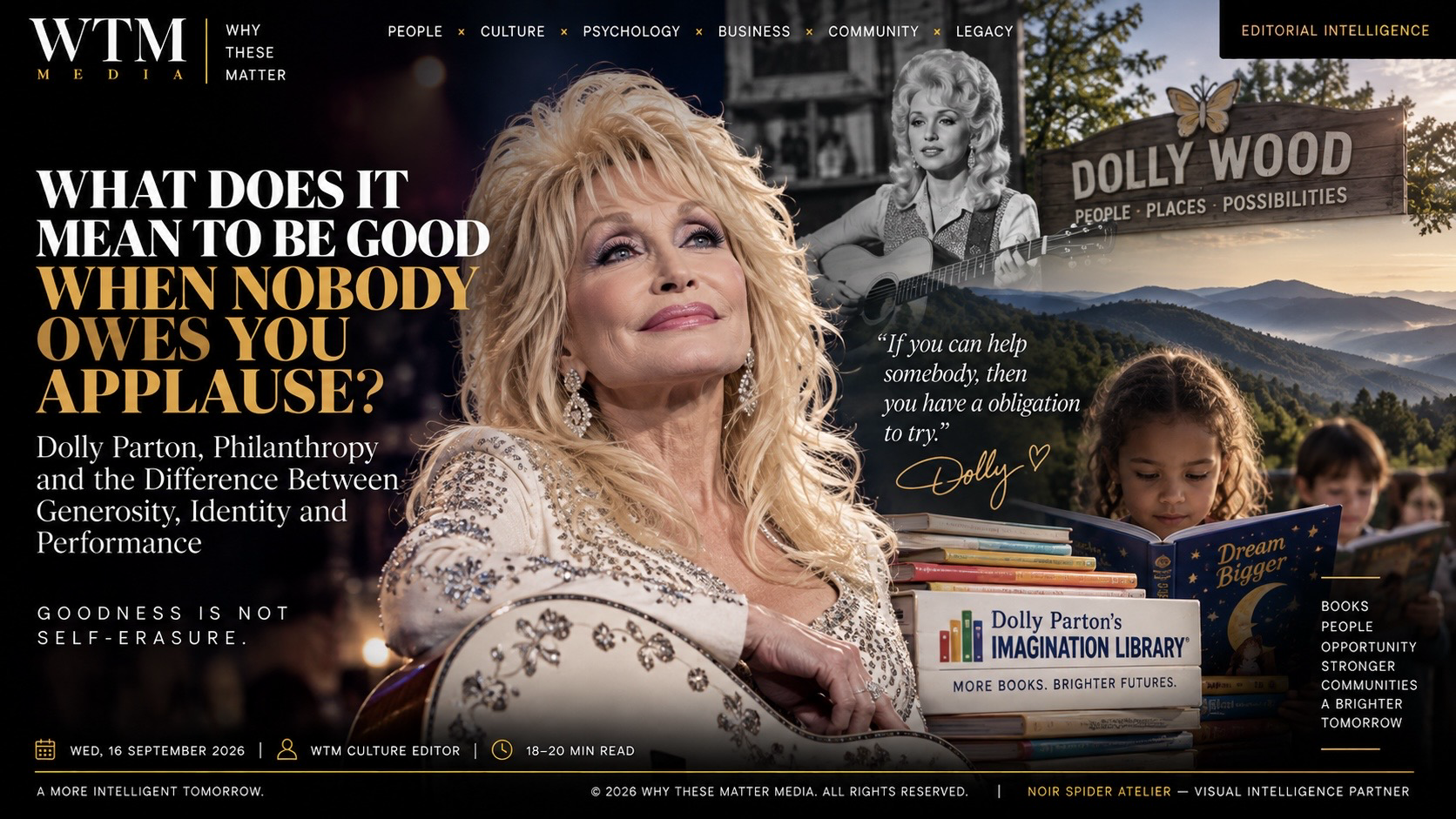
Dolly Parton, Philanthropy and the Difference Between Generosity, Identity and Performance

Dolly Parton, Philanthropy and the Difference Between Generosity, Identity and Performance

Dolly Parton died on 25 August 2026 at 80, leaving behind the obvious architecture of celebrity: songs, films, costumes, awards, businesses and an image recognisable across generations. Her official organisation described a seven-decade career and a legacy of philanthropy, compassion and resilience. But the more consequential inheritance may be found somewhere less glamorous. By June 2026, Dolly Parton’s Imagination Library was sending more than 3.5 million books a month to children across five countries and had distributed more than 325 million since the programme began in 1995. It started not as an abstract exercise in benevolence but from something personal: her father could not read or write. That distinction matters. We often describe goodness as though it requires the gradual disappearance of the self. Give more. Need less. Accommodate everyone. Remain available. Forgive endlessly. Never appear selfish. Under this model, goodness becomes a performance of personal depletion. But sustainable generosity requires almost the opposite. A person must possess enough self-knowledge to understand what they can give, enough boundaries to preserve the capacity from which giving occurs and enough judgement to distinguish helping someone from becoming responsible for their life. Parton offers a useful case study because her philanthropy did not require the destruction of her ambition, commercial instincts, aesthetic identity or ownership. She became extraordinarily successful and constructed mechanisms through which portions of that success could create value elsewhere. The mature architecture of goodness may therefore be: SELF → CAPACITY → RESPONSIBILITY → GENEROSITY → BOUNDARY → LEGACY. The question is not how much of yourself you can give away. It is whether what remains after you give is strong enough to keep generating value.

Download Visual Intelligence ↓
Trump, the $5,000 Promise and the New Attention Economy of American Power

Trump, the $5,000 Promise and the New Attention Economy of American Power

President Donald Trump’s proposal to send every American adult a $5,000 “Trump dividend” if Republicans retain control of Congress is striking partly because of its scale. Trump described the payment at the Republican midterm convention in Dallas. Reuters calculates that payments to roughly 240 million adult citizens would cost about $1.2 trillion; the Associated Press has placed the likely cost above $1 trillion, depending on eligibility. Congress controls federal appropriations, and neither a financing mechanism nor enacted legislative authority currently exists for such payments. Yet the cheque is not the most interesting part of the story. The more consequential development may be the communications architecture surrounding it. Political persuasion increasingly exists inside the same attention environment as advertising, entertainment, influencers, ecommerce and algorithmically distributed media. A policy no longer competes only against another policy. It competes against every other object seeking a person’s attention. Under those conditions, abstraction struggles. A phrase such as “long-term economic prosperity” must compete with something immediately understandable: $5,000. That does not make citizens irrational. Nor does it make every tangible political benefit improper. Democratic governments routinely tax, transfer, subsidise, insure and redistribute resources, and research shows that voters reasonably update their assessments of governments when policies materially affect their lives. The deeper problem appears when the distinction between governing and marketing becomes difficult to see. A political proposition can simultaneously possess economic value, perceived value, attention value and electoral value. Those values are not identical. The citizen therefore needs a new kind of literacy. Not merely: Do I like the offer? But: What exactly is being offered, who has authority to deliver it, what does it cost, what behaviour is the communication attempting to produce, and what remains persuasive after the spectacle disappears? That is where democratic judgement begins.

Download Visual Intelligence ↓
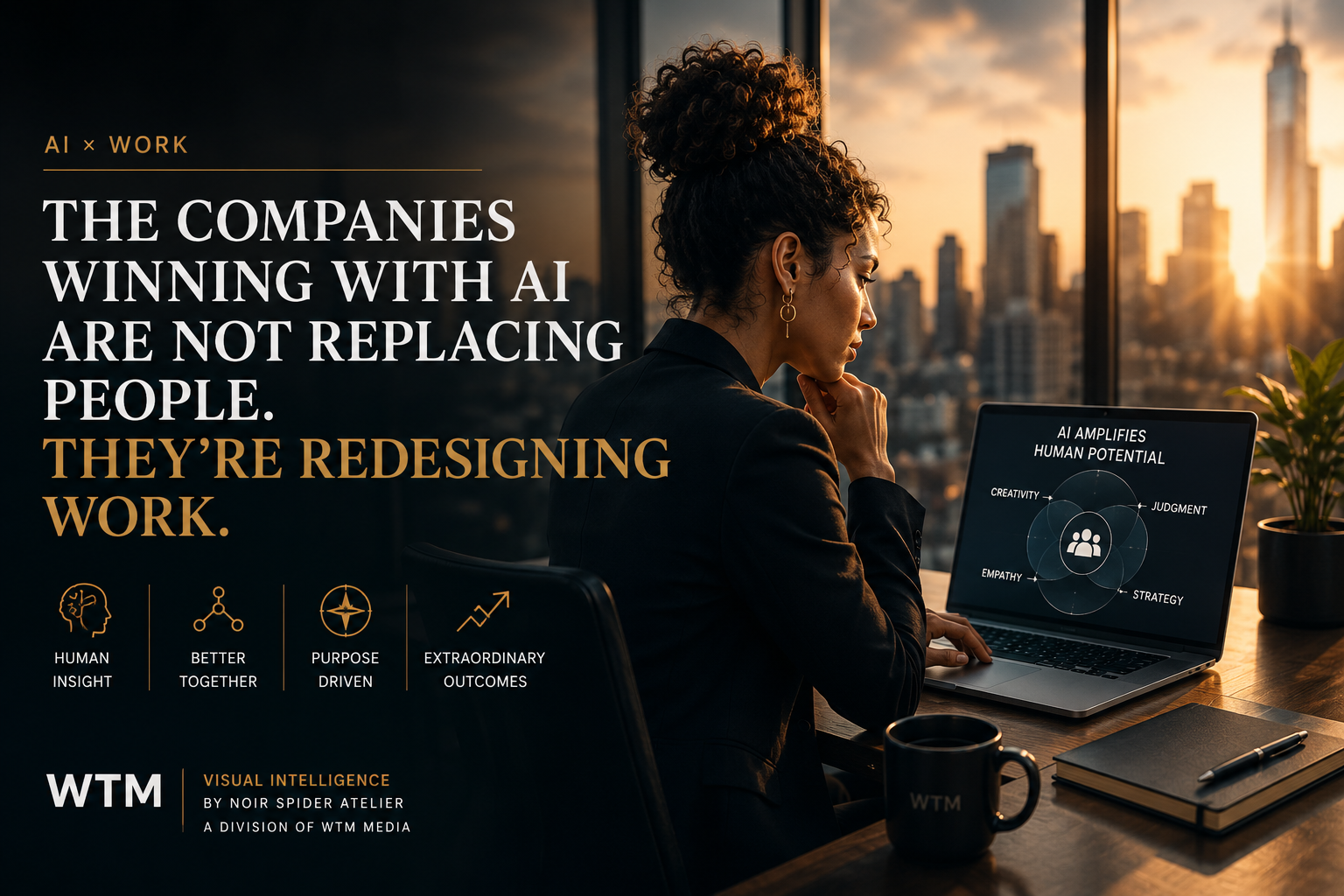
When Intelligence Becomes Cheap, Judgement Becomes Valuable

When Intelligence Becomes Cheap, Judgement Becomes Valuable

For the first phase of the generative AI revolution, companies rewarded adoption. Employees were encouraged to experiment, automate, prompt, accelerate and produce. Now a more difficult question is emerging. Once almost everyone has access to increasingly capable artificial intelligence, what actually distinguishes one worker, manager or organisation from another?. Ernst & Young’s US business has supplied an unusually concrete answer. In August 2026, EY announced a $100 million investment in employee rewards aimed not merely at technology adoption but at business acumen, judgement, adaptability, innovation, future-focused skills and exceptional client impact. The announcement is significant because compensation systems reveal what institutions believe has value. EY is effectively putting money behind a proposition that many organisations are only beginning to understand. The AI economy will require technical capability, but technical capability alone will not be enough. This is not the first time a machine has changed the value of human labour. Steam power changed physical production. Electricity reorganised factories. Mechanisation transformed textiles. Computers reorganised information work. ATMs automated transactions. Smartphones subsequently reorganised banking itself. Each revolution eliminated some activities, created others and, most importantly, changed what remained valuable for people to do. AI belongs to this history, but it introduces a profound difference. It reaches directly into work once assumed to demonstrate intelligence itself. The resulting challenge is not human versus machine. It is far more demanding. Organisations must decide what machines should do, what humans must continue to understand, how people will develop judgement when machines increasingly perform the tasks through which judgement was once learned and how value will be distributed when technology radically increases the productive capacity of labour. The machine can increasingly produce an answer. Someone still has to decide whether the answer deserves to become reality.

Download Visual Intelligence ↓
Who Are Your Three?

Who Are Your Three?

We have never possessed more ways to know people. We collect followers, contacts, colleagues, neighbours, group chats, professional networks and digital communities until connectivity itself begins to resemble security. Yet when life becomes consequential — illness, grief, unemployment, opportunity, conflict, reinvention, ageing, ambition — the enormous network often contracts remarkably quickly. The important question stops being how many people we know and becomes: who actually shows up?. Charlie’s Angels offers an unexpectedly useful doorway into that question. Its three protagonists are not powerful because they become alike. They remain distinctive personalities with different temperaments, capabilities and ways of seeing, yet learn to operate as a coordinated unit. That fictional architecture points towards something real in social science: adding a third person changes the structure of human interaction. Network research has long studied triadic relationships and the tendency of social networks to form triangles, while the Convoy Model of Social Relations describes how people move through life surrounded by changing layers of meaningful relationships that provide different forms of support. None of this proves that every human being requires exactly three people. Three is not a scientific prescription. It is a systems-thinking device. The more useful proposition is that resilient lives require more than reach. They require reciprocal relationships capable of performing different functions: someone who steadies us, someone who challenges us and someone who expands what we can see or become. WTM calls this the Personal Resilience Triad — not a psychological diagnosis or universal law, but a framework for interrogating the architecture of our closest relationships. And it contains a reciprocal obligation. The question is not merely Who are your three? It is also: Whose three are you?

Download Visual Intelligence ↓
Conceptual scene of intergenerational adult editors reviewing a publication together.

pathway-design

Noir Spider Atelier

Conceptual scene of eight diverse adult leaders and researchers exchanging ideas.

pathway-institutions

Noir Spider Atelier

Conceptual scene of three diverse adult collaborators learning visual storytelling together.

pathway-technology

Noir Spider Atelier